The EFCA Leader's Network
The Ministerial Association of the Evangelical Free Church of America
And He Sent a Wolf
By Pastor Kelly Larson (Bishop Creek Community Church, CA)
All in all, it had been a pretty good run, at least as far as church ministry goes.
My wife and I had been at Bishop Creek Community Church, in a beautiful area of central (eastern) California, for about six years and had seen the church grow considerably by God’s grace. We had good elders in place, children’s ministries were flourishing, and discipleship and small groups were growing.
The church was a “replant,” a rebooting of a church that had seen some pretty major leadership difficulties in its early years. It was a small church in a small town, but we had seen it grow from 10 to 20 people to a Sunday average of 75 regular attendees.
Things were going well. But then, seemingly out of nowhere, I began to feel a prompting to pray for protection. Protection? But why, Lord? We seem to be doing everything right, I thought. But that prompting continued. So, I began to pray for protection for our church from the outside, from the inside, and from myself.
As I continued to pray, lo and behold, there began a little unraveling along the edges of our church.
We had been meeting in a community center, enjoying the benefits of a great building and supporting our county. Out of the blue, we were abruptly given 60 days’ notice by the management. I was calm: we were used to moving; we had done it a number of times before and each time had continued to grow in the process. We landed safely in a new venue—or so I thought. Then a few more threads began to fray.
I felt frustrated and alarmed. Is this really how it’s supposed to work? I thought. After all, we had been faithful. Yes, we’d had a few hiccups along the way and made a few mistakes, but overall, we were walking the straight and narrow. Aren’t we, the faithful, supposed to be protected in the shadow of the Almighty?
Had I paid a little closer attention to the biblical witness, I would have remembered that where the Lord is at work, Satan can send a wolf.
Not sparing the flock
Paul cautioned the Ephesian elders to “be on guard for yourselves and for all the flock, among which the Holy Spirit has made you overseers, to shepherd the church of God which He purchased with His own blood. I know that after my departure savage wolves will come in among you, not sparing the flock” (Acts 20:28-29). That’s an ugly scene described, but I realized that I was failing to prepare for the inevitable.
In the Garden, Satan came himself (Genesis 3). In the desert, he had sent Korah and others to thwart Moses (Numbers 16). In the desert, he came himself to tempt Jesus (Luke 4:1). In the midst of the work of Christ, he sent Judas (John 13:2). Paul had his Alexander to deal with (2 Timothy 4:14-15) and John had his Diotrephes (3 John 9-10). And so it was in the case of our little church.
When I look back, I can clearly see multiple “wolves” that had entered our little church to impede the work of the Lord. It wasn’t that we were pleasing the Lord that protected us; it was the fact that we were pleasing the Lord that prompted the attack by Satan.
Wolves in our midst
Years later, I believe that I see things a bit more clearly. Now I understand what had been going on right under my nose: Where Lord’s work is successful, Satan will send a wolf; in our case, he sent a small pack!
These “wolves” came in, almost imperceptibly, under the gate and through the fences of our church. Over a period of six months, the so-called casualties mounted. I began to hear stories. Regular attendees began to disappear. I began to scrutinize people a little more closely and began to notice that some of the laces on the sheep costumes had loosened a bit. I learned that wolves could come in all shapes and sizes, old and young, male and female, but all present themselves as sheep.
Why would wolves be attracted to our little church? People are curious. Perhaps many just wanted to learn what was going on in our congregation. Perhaps others came for a more metaphorical feast, as a pack commissioned by Satan bent on feeding their own appetites (Philippians 3:19).
During this difficult period, people sought to divide and devour, gossip and slander, and destroy the body of Christ. We had welcomed them, desiring to grow the church and inviting people to use their gifts; after all, isn’t that what you do? The road back was tough. We spoke to those we could, addressed some of the issues from the pulpit and continued to pray for sovereign protection. It was a painful time, with consequences for our little flock, but we survived, thanks to God’s abundant grace.
Growing as a shepherd
As I reflect on this time, I have become more guarded and scrutinizing of new people coming into the flock. I am always eager to welcome them and love on them, but “vetting” takes a bit longer now in our little sheepfold. Following the principle in Paul’s words to Timothy, “Do not lay hands upon anyone too hastily and thereby share responsibility for the sins of others; keep yourself free from sin” (1 Timothy 5:22), I tend to be more cautious. Character is more difficult to discern than a person’s gifts.
I continue to examine the many passages of Scripture that caution against such canines within the walls of the church. I also hope that I am becoming a little wiser as a shepherd.
As a church, I am happy to say that we are better off now. We’re enjoying fruits of ministry once again, worshipping God, loving people and building mature disciples. We might be a smaller flock, but we’re healthier — and a little bit wiser now too. We know that as we continue to strive toward healthy ministry once again, we must be on our guard. In time, Satan could send another wolf or two.
[Kelly is an ordained minister with the Evangelical Free Church of America. Kelly and his wife, Suzanne, live in Bishop, California, where he is privileged to serve as the pastor to Bishop Creek Community Church. He blogs regularly at The Shepherd’s Pen.]
Not So Fast!
By Pastors Kelly Larson (Bishop Creek Community Church, CA)
Let’s say your church has been progressing nicely. Attendance is growing, and the community is flourishing. In the midst of this growth, your team decides that an additional staff person should be brought in to help ease the pressure on other leaders. You start to receive applications. He seems like a good fit. She has a strong résumé. Everyone cheerfully affirms the candidates.
The new hires all looked good on paper. But then, quite suddenly, things begin to unravel. In short order, it becomes clear that the new person is not a good fit. The church starts to experience divisions. People start leaving in droves. The district is called in to triage the damage.
Have you ever experienced this scenario at your church before?
It’s unfortunately a rather common occurrence, from my vantage point as a pastor. Why is this? The demands on a church are ever-present: There is always more ministry to be done, more people, more meetings, and yet a limited amount of precious time. Need is always knocking at the door. As my pastor used to say, “Sunday comes every three days!” Doesn’t it often feel like that?
As church leaders, we need help. In the spirit of Ephesians 4:14-16, we want to have “the whole body, being fitted and held together by what every joint supplies, according to the proper working of each individual part,” which “causes the growth of the body for the building up of itself in love.” We’re eager to bring on great, God-honoring fellow leaders. But in our eagerness, we may prematurely appoint individuals to leadership roles.
In the rush to hire church staff or fellow church leaders, I confess that I’ve missed a few of the “obvious” red flags along the way. Some people were clearly desiring to serve from misguided motives. Some, perhaps, presented as gifted instructors or dynamic leaders or as having the perfect theological “pedigree,” but these gifts never made up for the lack of character that was eventually revealed.
I share this because it’s my fear that in our urgent desire to fill positions, we are tempted to compromise. Sometimes, we think the best of people, or we hope for the best. Sometimes this obscures sound, Spirit-led judgment.
Poring over profiles, checking out referrals and conducting multiple job interviews may not sound like the pinnacle of pastoral pleasure, but this kind of methodical, intentional engagement in the hiring process can spare the congregation immeasurable despair. Though the most sincere efforts do not guarantee the absence of any future trouble, we can have a clean conscience that we have been thorough and sought to abide by the counsel of Scripture.
Assessing character is slow work
We should give weight to someone’s background and training, but it takes a long longer to vet his or her character.
Endorsements and references are helpful, but they don’t take the place of observation and personal verification of Christian character. How often have we allowed years on a résumé or impressive seminary degrees to be substituted for a deep, thorough character assessment? It takes time to observe a person’s integrity; it takes time to assess character.
The words of Paul to Timothy serve as a helpful guide to those of us in a position to hire leaders: “Do not lay hands upon anyone too hastily and thereby share responsibility for the sins of others; keep yourself free from sin” (1 Timothy 5:22; emphasis added). These are the wise words of a seasoned pastor to his protégé. Paul exhorts Timothy to avoid moving too quickly. In this way, he can protect his flock from future danger and chaos.
We ought to keep Paul’s words in mind when we consider hiring practices at our churches. Let’s be honest: Not everybody serving as a ministry leader should be serving as a ministry leader. Some have been squeezed in to fill a staff vacuum. Some were perhaps appointed because they exhibited a particular skill or had a great degree. Some had experience in another ministry. Some are there because a decision “had” to be made quickly. Many unfit leaders persist in roles that do not serve the body of Christ well. How many of these hires could have been avoided if we had followed Paul’s advice and taken our time?
Paul urges Timothy to consider many qualities in his fellow leaders: calling, competence, content, capability and, above all, character. These are in addition to the more “objective” requirements shared in Titus 1:5-9, 1 Timothy 3:1-7, and 1 Peter 5:1-4.
Talent or expertise never make up for a lack of character. Choosing men and women who will shepherd the flock requires careful observation and discernment.
The time it takes is the time it takes.
How should you vet candidates for roles in your church if you feel pressured to act quickly? Remember: You’re not on the clock, even if it feels like you are. The time it takes is the time it takes.
Some counsel to consider in this process:
- Never be in a hurry to make a mistake. It’s much more difficult to remove someone from ministry than it is to put them there. It is far better to leave the position open and struggle than to fill it and kill it with the wrong person.
- Don’t make the decision alone. Lean on others for perspective and counsel. And ask loads of questions.
- Start looking at potential candidates long before the position needs to be filled.
- Pray continually for the right person and for the candidates before you. Trust in God’s hand in this process.
Finding the right leader matters. It matters if the person is a denominational leader, a teaching pastor, an elder, a deacon, a worship leader, a Sunday school teacher or a children’s ministry staff member. Every person we bring on the team matters. Deciding to hire anyone in the church should be a decision that urges us all to act with prayerful judgment and wisdom.
We take our time in the hiring process because we love the Shepherd, and we love the sheep. We move slowly because it’s not a race; it’s ministry.
[Kelly is an ordained minister with the Evangelical Free Church of America. Kelly and his wife, Suzanne, live in Bishop, California, where he is privileged to serve as the pastor to Bishop Creek Community Church. He blogs regularly at The Shepherd’s Pen.]
The Preaching Sandbox
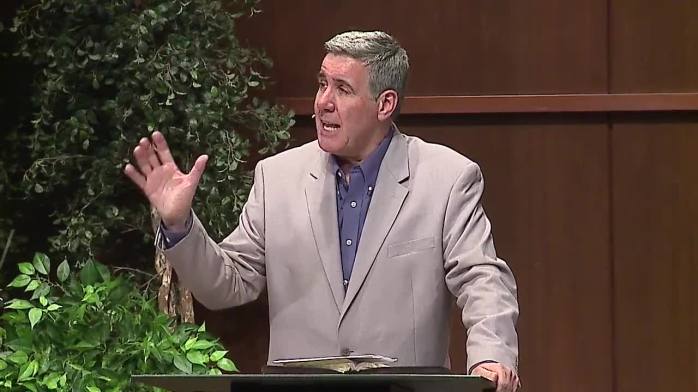 Pastor Colin Smith (The Orchard Church, Chicago)
Here is a super helpful framework for Biblical preaching from one of the great expositors in our movement:
This tool makes it clear that the central priority in preaching is to exalt Jesus Christ. “We proclaim Him!” “We resolved to know nothing among you except Christ and him crucified.” Do your messages move people to worship Jesus? Do they lift up the Lord so He can draw people to Himself?
With that primary goal in mind, the sandbox provides a four part evaluation:
- Is it Biblical – does it clearly emerge from Scripture and press home the key phrases in your text?
- Is it Theological – does it teach an important doctrine, helping people believe and apply it?
- Is it Clear – is it well organized and easy for people to follow?
- Is it Compelling – is it well illustrated to drive home the key points?
If you are not familiar with the ministry of Colin Smith check out his online ministry at Unlocking the Bible. Born and raised in Scotland, Colin served for 16 years at Enfield E Free Church in London, then came to Arlington Heights E Free in 1996 where he continues to serve. He has been shaped by the old British Puritans (John Owen, Robert Murray M’Cheyne) and the great European Reformers, plus more recent Bible preachers like Martin Lloyd Jones and theologians like A.W. Pink.
One of his most helpful Bible studies is called Momentum. With a very user friendly video format it walks you through the Beatitudes as a sequential pathway to change. This year Colin and his team set up an evangelistic site called Open The Bible to support a one year sermon series through Scripture. “The whole Bible is one story and it all points to Jesus.”
Feed the Sheep that Come
 By Pastor Kelly Larson (Bishop Creek Community Church, CA)
Serving a church in a geographically remote small town presents no small amount of challenges.
Perhaps the most obvious challenge is the simple number of people available for any given church event. When my family relocated from a metropolitan church, which was itself larger than the entire city that surrounded it, to a charming town in the Eastern Sierras, you could imagine that a certain “adjustment” would be required. When I looked out over the new congregation from the pulpit on my very first Sunday, I could see that this was an understatement.
Any given Sunday tended to yield between 20 and 50 worshippers. Sometimes, I found myself counting the bodies who weren’t there as opposed to those who were. In a large church, 25 people may not be missed, but in a church of our size, even 5 absent people were oh-so obvious.
I’m sad to say that my mood was often altered by a lower headcount on Sundays. Hey, where was everybody? I’d think. I’m here; why aren’t they? I spent a lot of time working on this sermon! The truth was, it was just a small town. People had places to go and family to see. Some had medical appointments, many of which happened out of town. Some people, still in town, had other things going on.
I am still aware of low numbers, of course, but I had an epiphany several years back. It was this: Feed the sheep that come.
The sheep who didn’t show up wouldn’t receive whatever had been prepared for that morning’s service, but I had to ask myself: Were the ones who showed up deserving of my somewhat sour attitude? Were the people here still going to get the very best of what God had given to me?
Truly, there was only one answer. God had placed me here. The flock had come to be nourished.
God said in Jeremiah, “Then I will give you shepherds after My own heart, who will feed you on knowledge and understanding” (Jeremiah 3:15). God has allowed me to be the one who fed the sheep that day. If our hearts are seeking after the heart of God, our desire will be to nurture those sheep, any sheep, in Christ, walking them just a little closer to the Chief Shepherd than they were when they first came through the door.
There are many reasons why those pews may not be filled. I’d guess that it’s this way all across the globe: Some sheep will make it to the fold on Sunday morning or Wednesday evening or whenever, and others will not. Life is busy; time is being eaten away on our calendars. It’ll be this way until the Lord returns in glory.
It may be a small worship service turnout. It may be a few souls who make their way to a prison Bible study. It may be a little midweek gathering of two or three people. It may be a couple of small lambs in a Sunday school class. It may be simply one willing disciple ready to learn. No matter how many people are there, never underestimate those souls whom Christ has entrusted to your care that day.
If you have been called to shepherd, never forget and never take lightly the divine commission to oversee His flock. I think of the great words of Christ to Peter in John 21: “Do you love me?” “Tend my lambs.” “Do you love me?” “Shepherd my sheep.” “Do you love me?” “Tend my sheep” (John 21:15-17).
Do you love Him? Feed the sheep that come.
[Kelly is an ordained minister with the Evangelical Free Church of America. Kelly and his wife, Suzanne, live in Bishop, California, where he is privileged to serve as the pastor to Bishop Creek Community Church. He blogs regularly at The Shepherd’s Pen.]
The Call of the Shepherd
By Pastor Kelly Larson (Bishop Creek Community Church, CA)
In my office upon the wall, near the door hangs a picture; it is a gift I received from a friend shortly after entering the pastorate. It serves as a sober reminder of the privileged call which God has placed upon my life. It is a reminder as I leave for the day, and as I return from the battle in which I am engaged – a battle which is consuming, in time and energy, and at times, in casualties.
You see it is a simple picture, perhaps from the early 1920’s of a sheepdog, perched upon a rock formation intently monitoring a flock of sheep, perhaps thirty or so in number, in the dell below. The sheep are intently gazing to the north, the setting sun falling behind the outcropping of trees in the distance. It is a picture by R.A. Fox entitled “A Reliable Guardian.” So, why would a picture like this affect me so?
It is a reminder of the calling God has placed upon me to be an under-shepherd to the flock of Christ. It is a sober alert of the ever-present threat upon the body of Christ in our post-Christian culture, to protect the flock, from the outside, from the inside, and even from themselves.
When God called me to be a shepherd, I believe he was not looking simply for a “leader”; he was looking for a shepherd. He was not looking for a great communicator, speaker, or an orator, catalyst, strategist, CEO type who has been a part of Fortune 500, or facilitator; or even a teacher. He was looking for a pastor who could effectively handle the word of God in his communication, and walk alongside the sheep for the journey. He was not looking for a “strategist to conceptualize, implement and assign analytically synthesized congregational components conducive to systematic holiness paradigms” – once again, he was looking for a shepherd to foster a love of God and others. I am not saying those gifts aren’t useful, or that they may not eventually translate into effective shepherding, but they are not in themselves, shepherding. A shepherd shepherds.
Congregants are not simply components of a church equation, they are people whom God has placed under our care, custody and authority – to love, nurture, and grow into the image of Christ. I think of a Shepherd dog, Lydia, here in Bishop. As a shepherding dog with shepherding in her DNA, and being around livestock it was her routine to surround and motivate all able parties in her scope of influence to move toward the shepherd of the home, my friend Laura. As Laura would walk, or even when she sat Lydia herded chickens, pheasants, cattle, other dogs and yes, even toddlers closer and closer to her master. I remember she even tried to herd me closer to Laura. That was her task, and she took it seriously. Half of the time, I don’t think all those creatures even realized she was very intentional to bring everything around closer to the shepherd of the home, but she did. I have been reminded of that commission more than once, that it is my privilege as under-shepherd to move God’s sheep, a little closer to the Chief Shepherd.
“Tend my lambs,” “Shepherd my sheep,” “Tend my sheep.” Taken to heart, these are some of the most sobering words of pastoral commission to fall upon any shepherd’s ears. These words of Christ to Peter in John 21:15-18 are still an unfathomable conundrum to me. The difficulty is not solely in understanding their content, but in understanding their desired conduct to affect that obedience; how I am to obey them – feeding and shepherding the sheep in God’s flock.
Somehow, I’m guessing that I am not alone; an understanding of our own great deficiencies hits us all too often. You don’t have to be in pastoral ministry too long before you become keenly sympathetic to those who have pioneered before you and decided that teaching is more the preferred calling. Or that writing is more in line with leading a serene and peaceful life. It comes as no surprise the discouraging statistics of pastoral “wreckage” strewn alongside the highway of ministry that cause some to find employment in a more secular vocation. If we were to rely on statistics alone, they are certainly against us. Suffice it to say that the career lifespan of a pastor is a challenge.
Coming out of Bible college, or the Academy, I felt that if I could just exposit the word with authority; if I could rightly divide God’s word, people would flock into the church and willfully surrender to the transformational truths of biblical teaching. Coming out of the Academy, we are naively ready to launch into virtually anything shepherding has for us.
I loved seminary, yet one thing it often fails to identify is that the sheep in the Kingdom are a very specialized hybrid-highly intelligent, at times carnivorous, and have an incredible desire to exercise their free wills. I have been lied to, lied about, maligned, ignored, gossiped about, slandered, and threatened, and that’s on a good day – what pastor hasn’t? Moses dealt with this. In Exodus, he is advocating for the sheep who God is desiring to terminate. Yet, only chapters later he is crying out to the Lord to deliver him from the stiff-neck people.
The truth is that, in our humanity, we sometimes minister to people daily who we may not particularly like so much, care for, or are drawn to. We are seeking to lead sheep who do not want to be led; to feed sheep who do not want to eat, and to tend those who by no means want to be tended to. I find it interesting how congregants want to hold pastors to some measure of biblical leadership, yet disallow themselves to be held to any measure of biblical discipleship or stewardship. So effectively, people who do not want to be taught or led, nor accountable. We are discouraged by the empty seats on Sunday rather than encouraged by the one which is filled. We have difficulty recognizing true transformational growth in the flock.
Like Moses, we ask, “Lord, why did you call me?” Sometimes we get to the point where we ask ourselves, “What am I doing?” “What am I doing here?” Or maybe, “What did I do wrong to get here?”
Like Peter we affirm our love for Christ, yet are ill-equipped to fulfill with complete integrity and faithfulness the mantle of service to the Lord and His flock.
Be that as it may, what an honor it is to be called to feed the sheep that come. Still, we know we have received a privileged call to shepherd his sheep, to walk alongside, to walk them home. But we can’t change the sheep – that is up to the Holy Spirit and the obedience of the sheep. We can’t change the culture of the church, at least overnight. So, we need to be content to change that which we can.
Maybe you are just beginning your sojourn of ministry. Maybe you’ve been on it a while, a little closer to the goal line. Maybe you’re in a time of blessing, or a time of challenge. Maybe you are in need of a little encouragement, well-intentioned souls to encourage you. Either way, The EFCA Network is intended to help you, even encourage you in your pastoral journey, and hopefully let you know that others have walked, and are walking the same terrain.
[Kelly Larson is an ordained minister with the Evangelical Free Church of America. He completed his PhD in Systematic Theology at South African Theological Seminary in 2015, and he holds an MA in Christian Apologetics from Biola University. Kelly and his wife Suzanne live in Bishop, California where he is privileged to serve as the pastor to Bishop Creek Community Church. He blogs regularly at TheShepherdsPen.com.]
Your Free Church Hero?
The Network Board is searching for stories! Who is your Free Church hero? We are mainly looking for stories of men and women who are retired from active ministry or who have gone home to the Lord.
Who inspired you? Who helped you become the leader you are? Who taught you and showed you what the EFCA was all about?
Please record a video of you telling your story, upload it to google drive or dropbox and and send the shareable link to efcanetwork@gmail.com. We will compile these stories into collections and post them to our blog and a video page on the site.
We are now The Network!
Many thanks to the MA members who came to the presentation and business meeting last night. It was encouraging to sense the unity and excitement in the room as we remembered our history (check out the new 4 minute video!), focused on our values and looked ahead to our new approach.
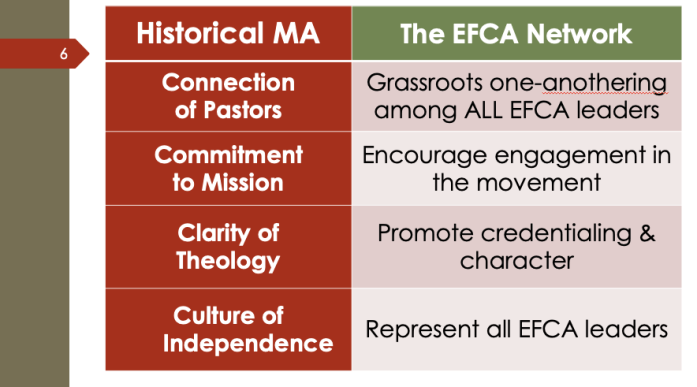
Here is the presentation if you’d like to review what we discussed. This slide shows our desire to preserve the historic values of our association.
Here is the packet we handed out if you’d like to look over the details of the change.
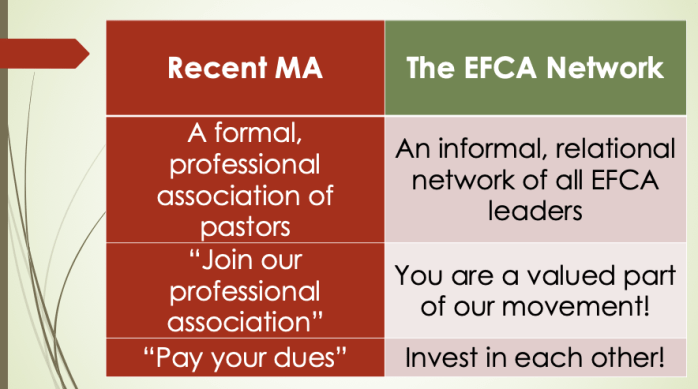
These slides show the primary points we are changing:

Please welcome our two new board members:
- Jon Payne – District Superintendent for the Forest Lakes District (WI).
- Clinton Hogrefe – Senior Pastor in Stanton, NE
They will be joining our new chairman – Todd Hessel (Lead Pastor of Ankeny Free in Iowa) – and continuing members Kelly Larson (Lead Pastor in Bishop Creek, CA) and Paulo Freire (Lead Pastor in NJ).
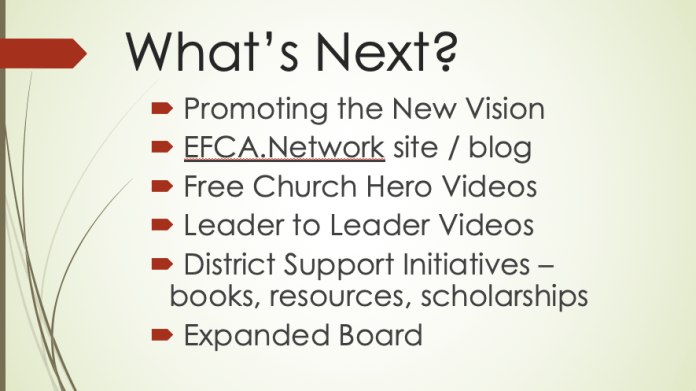
Here’s what’s coming in 2019!
If you are a part of the EFCA, welcome to the Network! Whether you are a pastor, missionary, chaplain or ministry director, you are the Network. We are the Network. Every time we meet together; every time we encourage each other; every time we serve together – we live out the vision for the Network!
MA History Video
Check out this four minute summary of our history and the legacy of our commitment to bringing pastors and leaders together!
Unity in the Essentials
The Evangelical Free Church is known for its commitment to the authority of Scripture and the centrality of the Gospel. The Bible is our foundation and the cross of Jesus Christ is our center. This dual commitment gives us fierce clarity on the essential doctrines of the faith and broad freedom when it comes to secondary matters. 
We are a centrist movement – committed to keeping the main thing the main thing. Pastor Brian Walker of Lake Morton Community Church (an EFC in Lakeland, FL) presented this beautifully in a recent message. He said, “If we downplay the importance of doctrine and don’t draw any lines on essential beliefs we can slide into liberalism. But if we make every single point of doctrine an essential teaching we can slide into fundamentalism.”
Unity in the essentials and “dialogue in our differences” (Greg Strand) protects us from either error. There are some hills that are worth dying on such as the inerrancy, authority and sufficiency of Scripture, the Trinity, and salvation by grace alone through faith alone. But most other theological hills are simply not worth fighting over – the age of the earth, the timing and mode of baptism, the use of the supernatural gifts, the nature of Jesus’ return relative to the Millennium, etc.
It is good for us to have beliefs and convictions on issues like this – but they are not worth dividing over. There is so much for us to celebrate that we have in common with brothers and sisters from other traditions who share our central beliefs on the Bible, the Trinity and the Gospel. Let’s make room for people with different views on secondary matters and sharpen each other with our differences. And let’s partner together with everyone we can to bring the love and truth of Jesus to every part of our city and every people group on earth!
For more on “theological triage” check out this helpful article from the Gospel Coalition (a wonderfully unifying and evangelically centrist network).
Brian preached this sermon as part of a five way pulpit swap among EFCA pastors in central Florida. Ryan Schmitz (Trinity E Free in Eustis, FL) suggested the idea at a spring pastor gathering in order to promote more prayer for one another. The five pastors chose to speak on five core convictions in our movement, including Brian’s topic of unity in the essentials. We also addressed our ultimate purpose to glorify God, our focus on multiplying disciples, our commitment to proclaiming the Gospel and our foundation in the Word of God.
What is the Network?
WE ARE the Network. If you are a leader in the EFCA, then you are a part of our Ministerial Association. We picture our movement as a cross-shaped tree for we are Christ-centered. The leaves represent the diversity and unity of our movement as we seek to multiply all kinds of churches among all people groups on earth, yet we are One EFCA.
We thank God for the faithful servant leaders who have built sturdy and efficient structures to support the growth of our movement. District offices, the National team, Reach Global and our chaplaincy program each provide a trellis on which the EFCA vine is growing.
The Network is the root system of our movement. Thousands of EFCA leaders, overlapping, intersecting and growing together in pursuit of our common mission to glorify God as we multiply transformational churches among all peoples.
The Ministerial Association has always been about connecting EFCA leaders with one another for three central purposes:
- Character
- Clarity in our theology
- Commitment to our mission
The first 37 EFCA pastors formed the Ministerial Association in 1894 to protect the character and integrity of our growing movement. Definition had to be given to who was a recognized Free Church Pastor and who was not. This was tightly bound to clarity in our theology – founded on the truth and authority of Scripture and centered on the essential doctrines of the faith. And those pastors knew they would be “better together” with joint commitment to collaborate on both national and international missions.
These remain our core values as a Network. We seek to promote the EFCA culture of Biblically-grounded, Gospel-centered partnership for the building of Jesus’ church and the unending glory of God. The main way we do this is simply by encouraging leaders in what makes us “Free Church” people. This is about our identity and our ethos. It is about deepening our roots in Scripture and the Gospel and about strengthening our ties with one another. The Network is the “one anothering” of the EFCA.
If the root system of the EFCA grows deeper and wider through a strong and diverse Network of interdependent leaders the vine will flourish! That is our prayer and our plan and we give thanks to our sovereign and creative God for each leader and what you bring to the family tree!
 The EFCA Leader's Network